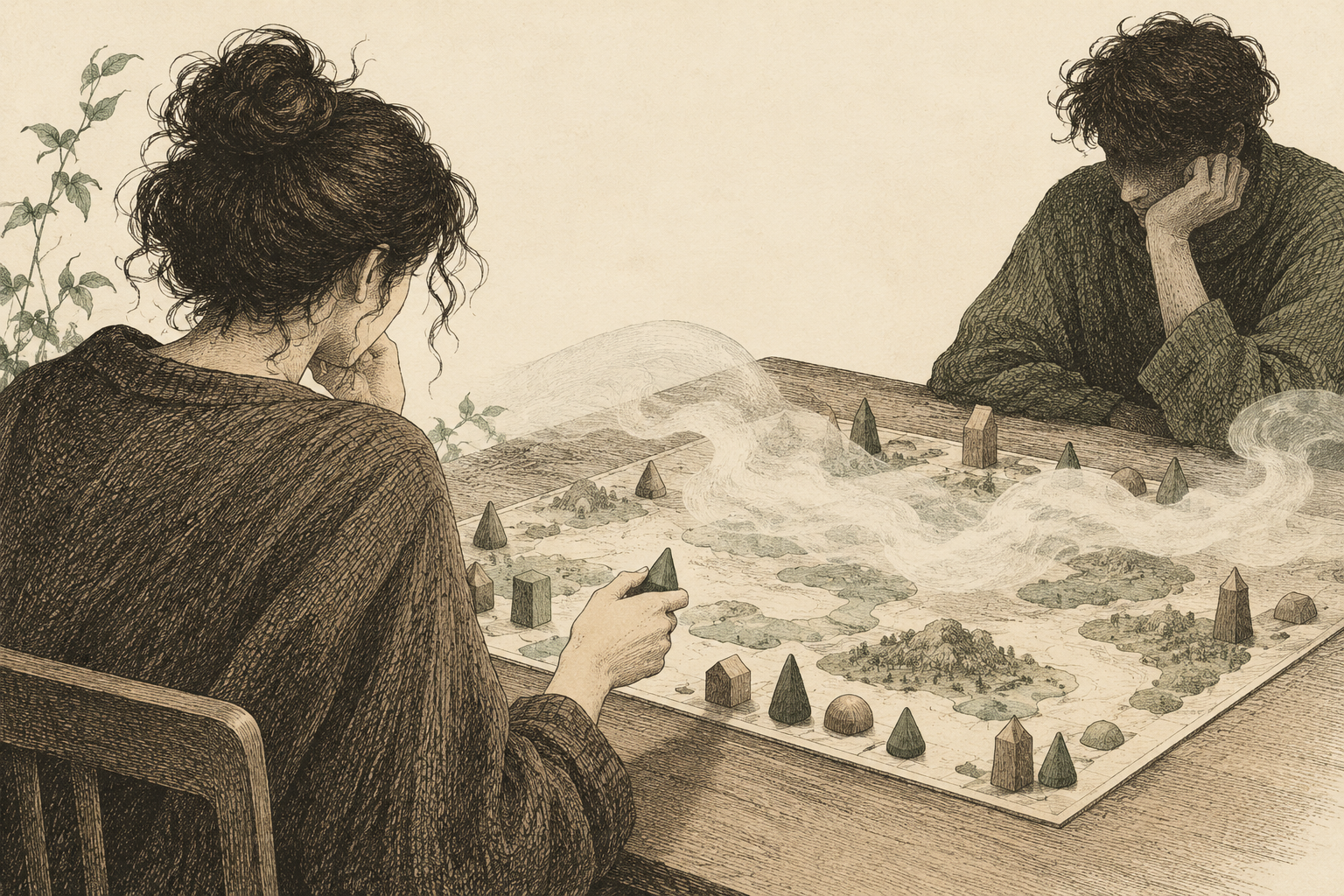
You can see your opponent’s pieces. You just cannot see what they are. The board is visible; the crucial information is not.
That is one of the inconveniences built into Stratego. Only a piece’s owner knows its identity, until movement and combat gradually reveal more. Thinking well is not simply a matter of calculating precisely from what is visible. It is also a matter of deciding which possibilities to keep open.
A familiar workplace equivalent might be waiting for a customer to reply. Is the price a problem? Is an internal approval taking time? Have their priorities changed? One observation, no reply, generates several possible worlds. Somewhere along the way, we may quietly start treating one of them as a fact.
Not just one imagined board
Ataraxos, developed by Samuel Sokota and colleagues, combines self-play reinforcement learning with decision-time search under imperfect information. It learns a policy through playing against itself and trains a separate network to model hidden information. Before choosing a move, it samples possible hidden configurations, tries candidate actions across them and updates its decision. [1]
It does not first paint every unknown piece with a single presumed identity. It reasons about a move while retaining different possibilities. The order matters. What is unknown is not debris to clear away before thinking begins. It is part of what thinking must work with.
The learning process also has a distinctive design. The researchers coordinate the size of policy updates with the strength of regularization. Under imperfect information, a change in your strategy changes which strategies are advantageous to your opponent. What feels like rapid improvement can turn into cycling or instability. Changing quickly and remaining capable of change are not the same thing.
It would be careless to turn this directly into a management maxim. The mechanism has not demonstrated how human organizations should change. Still, it leaves us with a useful distinction: increasing the size of an update is not the only way to accelerate learning.
Winning, and what was won
In 20 Stratego games against the accomplished player Pim Niemeijer, Ataraxos recorded 15 wins, one loss and four draws. Counting a draw as half a win gives an effective win rate of 85%. The researchers also applied the underlying design to other games, including cooperative Hanabi and the team game dou dizhu. [1]
That is a strong result. It is also a result whose main evaluation involved one opponent. A human can learn an opponent’s habits over a series; the games cannot simply be treated as independent, identical draws from a lottery. The authors explicitly acknowledge this. Nor does performance in these games establish performance in real negotiations or business decisions.
On a board, the rules are specified. So is winning. A fast, accurate simulator is available. In work, what a customer wants and what we ourselves want to achieve can change along the way. Estimating hidden pieces is one difficulty. Not knowing which game you are playing is another.
A place for what we do not know
Here is an editorial question prompted by the research: could our meetings make room for several possible boards?
Instead of refining a single explanation, “the customer dislikes the price,” we could keep three situations in view: a pricing problem, an internal approval delay and a change in priorities. We could then ask which next action is relatively safe across them, and which observation would let us eliminate one. This is not merely an optimistic, neutral and pessimistic forecast. It changes the contents of our uncertainty.
Of course, multiplying conceivable situations can continue forever. Nor must every possibility receive equal weight. The task is to create a workable space between closing too early around a convenient explanation and refusing ever to decide.
When consulting an AI, we can ask not only for an answer but for the assumptions that would change it. Once those assumptions are visible, the next thing to investigate may become clearer. This is not a meeting technique whose effectiveness the study tested. It is our own hypothesis about carrying the insight beyond the board.
Knowing more can improve a decision. But a decision cannot always wait until knowing is finished. There is a difference between eliminating the unknown and acting while allowing it to remain unknown. An unturned piece quietly keeps that distinction in view.
When we choose our next move, what are we still allowing ourselves not to know?