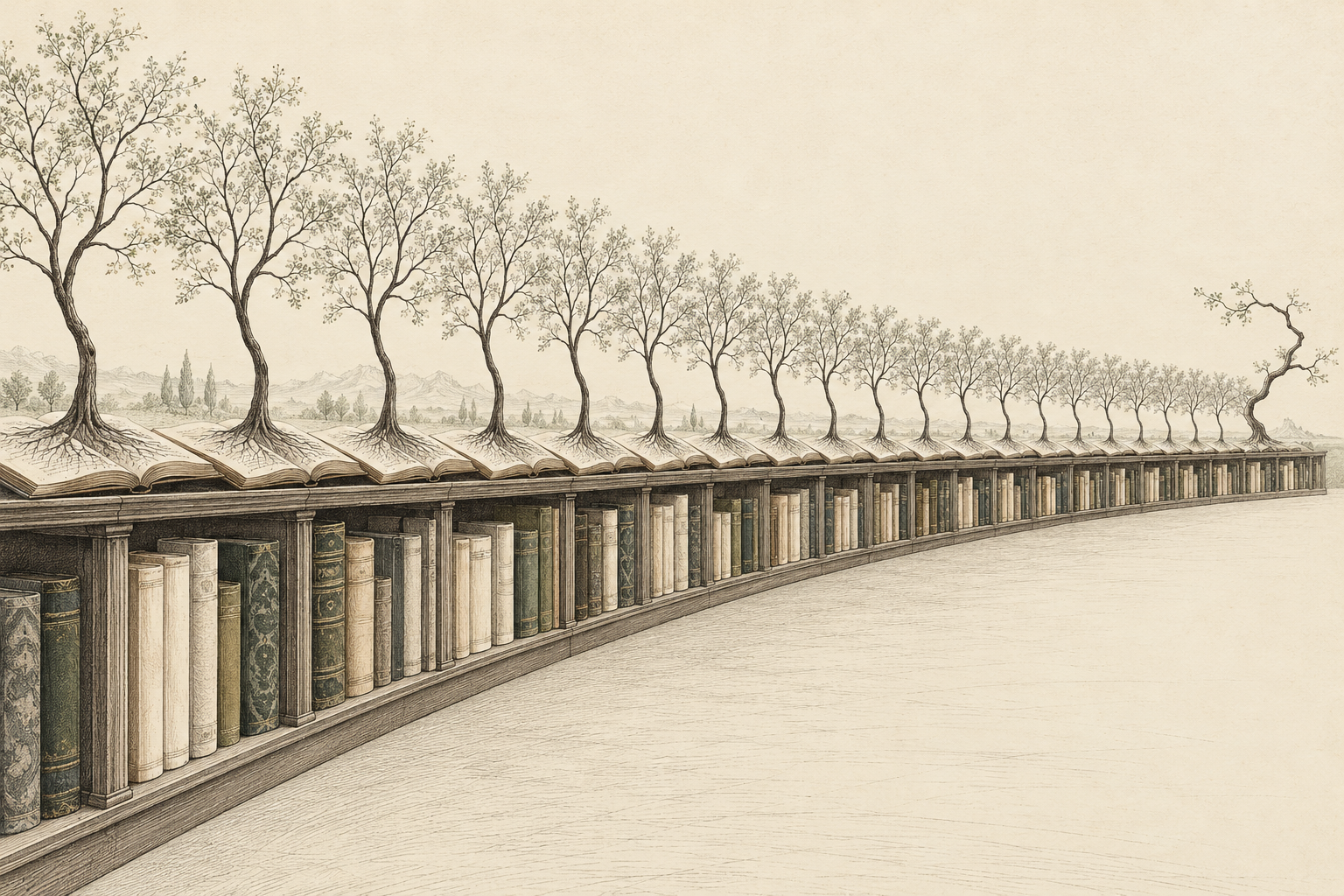
The first one is good. The second is good too. By the third, you begin to feel you have met it somewhere before.
Each is appealing, yet together they seem less different. Can that happen? If we measure creativity only through individual scores, the question is easy to miss.
In a short-story experiment, Anil R. Doshi and Oliver P. Hauser examined the ratings of individual works separately from how similar the works were to one another. Improvement for the individual, they found, need not move in the same direction as diversity across the group. [1]
A three-sentence foothold on a blank page
The 293 participants wrote eight-sentence stories in English. They were randomly assigned to write without AI, to have access to at most one GPT-4 story idea, or to have access to as many as five.
This was not an experiment in having AI write the finished story. Writers received a three-sentence starting point, then developed the story themselves. They could not keep consulting the model freely or try prompts of their own choosing. The experiment placed a small foothold in front of a blank page.
A separate group of 600 people rated the finished stories, assessing novelty, usefulness, and other qualities before being told whether AI had been used. In the up-to-five-ideas condition, novelty ratings were 8.1% higher and usefulness ratings 9.0% higher than without AI. [1]
Usefulness here does not mean sales. It includes readers' assessments of suitability for the intended audience and potential to develop into a longer book. And access to five ideas does not mean everyone used five. The study measures the effect of making that option available.
Time spent unable to think of anything becomes time in which writing can begin. At least in this task, access to AI-generated ideas improved how the work was rated.
A fresh story, a more familiar bookshelf
Look at the works together, however, and another change appears.
The researchers converted the text into numerical representations and examined similarity within each experimental condition. When writers had access to AI ideas, their stories were more similar to the others than in the no-AI condition. Higher ratings for individual works and a wider range across the collection were different outcomes.
There is no contradiction. Asking whether a story feels fresh is different from asking whether it goes somewhere none of the other dozens of stories goes. More good books do not necessarily mean more destinations on the bookshelf.
That does not mean everyone wrote the same story. The measure was a change in similarity using text embeddings. It was not a plagiarism test, nor proof that every subject and style had become identical. “AI erases individuality” would race far beyond the evidence.
Eight-sentence stories, a particular model, and a fixed way of asking for ideas. Whether the same result holds for professional writers revising over months, for music, or for product concepts remains a separate question.
How many kinds of good idea do we have?
Let us bring this tension closer to work.
We score proposals one by one. Each is more polished than before: clearer, more complete, easier to explain. That is a welcome improvement. But if the final set all addresses the same customer, the same problem, and the same kind of solution, the room to choose may barely have grown.
Is “Give me more ideas” enough? More candidates in a similar place may simply make selection busier. A rich set of options and a large bundle can look remarkably alike.
There are things worth trying. Write down separate starting points before looking at AI's ideas. Bring examples from different workplaces. Ask what makes a proposal different, separately from how polished it is. These are not remedies validated by this experiment. They are hypotheses about preserving diversity that would need comparison in practice.
Nor does every job call for maximum diversity. We would not want a standard notice to be startlingly original every time, and an evacuation sign has little need of an author's signature style. It is more useful to distinguish work in which consistency matters from work in which we are exploring different possibilities.
For an individual, borrowing AI's help can be a reasonable choice. There is no need to distrust every improvement. But what a group possesses collectively does not appear on any one person's report card. Looking at that requires a separate role.
This paper leaves us with a question slightly more awkward, and richer, than whether to use AI. Can we enjoy the improvement in our own work while still noticing how it differs from the work beside it?
On a bookshelf with a higher average score, can we still encounter a book we did not expect?