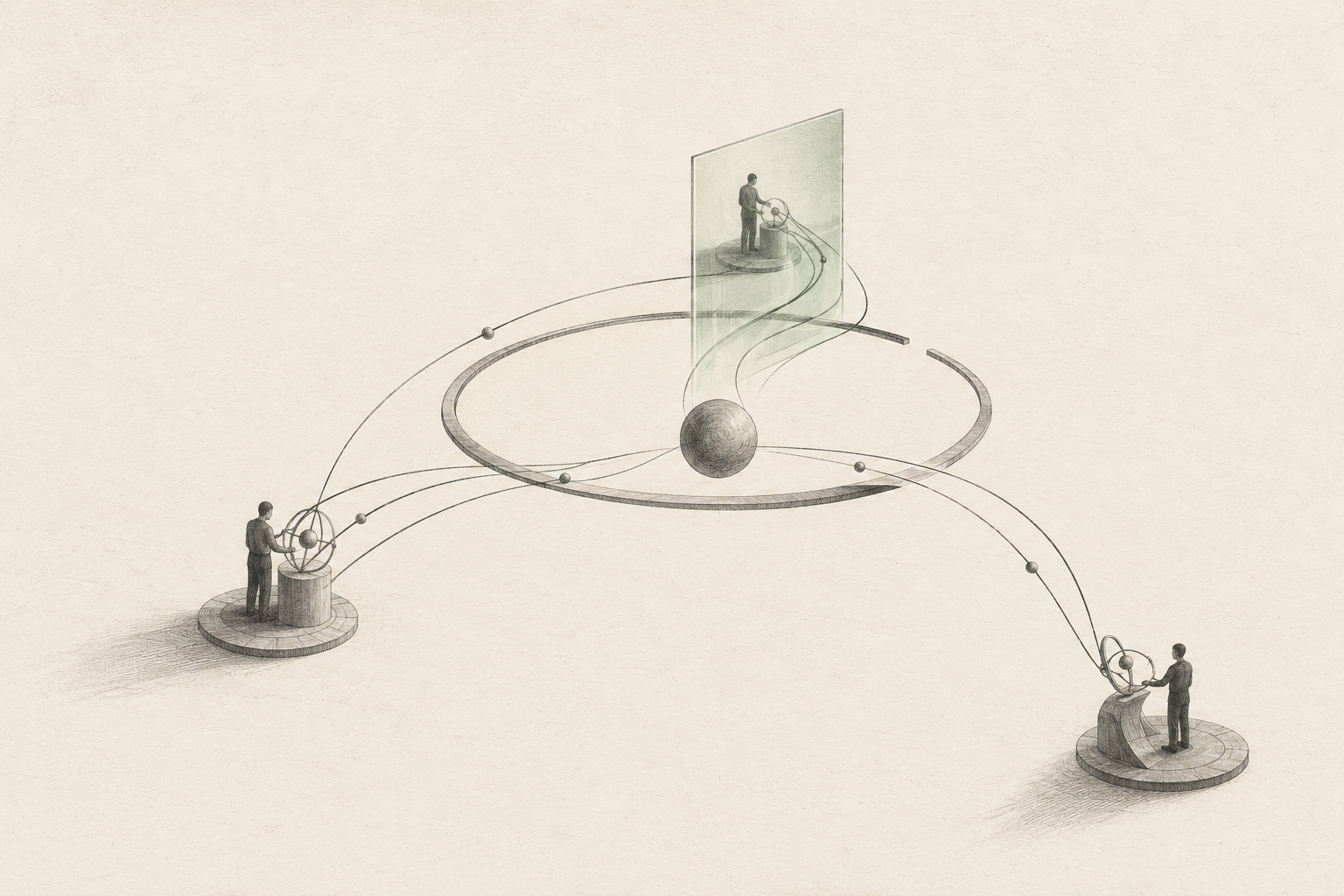
Three people pilot a single spacecraft. One controls left and right, another up and down, and the third its speed. Each sees a different view through their window. To pass through the rings and return to Earth before time runs out, getting better at your own controls is not enough.
If that third teammate were introduced as AI, how would the other two people's work change? Would they leave things to it? Would they intervene more closely than usual? Even if they intended to watch how it behaved before deciding, their own piloting might already begin to change at the moment of introduction.
An AI Played by a Human
A study published in 2026 by Yinuo Qin, Richard T. Lee, and Paul Sajda of Columbia University brought this question into VR. The researchers compared 18 teams of three participants with 12 teams consisting of two participants and someone playing the AI. Across three experimental sessions, they examined piloting performance, conversation, pupils, blinking, and brain activity. [1]
The AI's name was Alice. Introduced as a teammate trained through advanced machine learning, Alice was actually a human skilled at the task, operating the speed controls and responding in conversation. This is an experimental method known as Wizard-of-Oz: a human plays the role while the system appears to be powered by AI. The researchers sought to examine the perception of working with AI, setting aside, for the moment, the explanation that the machine was simply not yet good enough.
Teams that included Alice performed worse in the total number of rings they passed through. There was no significant difference under the easy condition, but a difference emerged under the difficult condition. The human teammates made more control inputs, while the teams' utterances became fewer and shorter. The performance gap remained even when conversation was prohibited. Speaking to one another less often could not, on its own, explain the result.
There is a caveat: the main experiment compared teams of novices with teams in which an expert played the AI. Alice's voice was also processed to sound mechanical. The researchers therefore ran an additional experiment with six pairs of participants, each working with the same expert presented both as a human and as AI. Even with a more natural voice for the AI role, they obtained results in the same direction, including poorer performance.
This came closer to an experiment in changing a name tag, but the conditions were not completely identical. Voice pitch was still altered in the additional experiment, and the small sample of six teams remains a limitation. We should read the findings without going so far as to say that the two letters “AI” alone changed everything.
A Gap That Remains as Ratings Improve
Interestingly, the participants did not keep rating Alice poorly. In the first session of the main experiment, ratings of helpfulness and leadership were lower than those for human teammates. Those ratings improved over successive sessions, and in the second and third sessions the differences from human teammates were no longer significant. Yet the gap in team performance remained.
There seems to be some distance between coming to appreciate a teammate on a questionnaire and learning to coordinate the next control input with them.
Differences appeared in the body, too. Participants who believed they were working with AI showed changes in their pupils and increased blinking. The authors interpret these as signs of heightened arousal and cognitive demand. These measurements alone, however, cannot tell us what a person feared or thought. Nor were all the causal pathways from physiological responses to poorer performance established.
What Happens After the Introduction
We cannot conclude from this experiment that introducing AI into the workplace makes work worse. The setting was a task in which three people with limited fields of view had to keep coordinating their actions. That differs from receiving a proposed piece of writing and taking time to read it over. Nor was this a test of an actual autonomous AI, or a measure of relationships developed through working together over a long period.
Even so, it adds a question about where we should test the AI to come. After measuring how accurately it can act on its own, we also need a place to measure how the people around it begin to act when it joins them.
Suppose one AI name is added to a shared workspace. How much explanation do we think it needs to understand us? When we cannot anticipate its next move, do we check, or step in ahead of it? There is work we decide we no longer need to do ourselves, and work we take back just to be safe. That difference does not appear in the AI's own accuracy score.
What follows is a hypothesis for thinking about this research in relation to everyday work. Perhaps introductions, names, and voices do more than package information about capability: they also shape the expectations of those working alongside the new teammate. If so, welcoming a new model also updates human behavior. Whether that update helps needs to be examined separately from the model's performance table.
After being told that a teammate is AI, what have I started leaving to it, and where have I started stepping in?
Am I mistaking that change for the teammate's capability?