When someone says “push the red thing,” we can draw on “red” and “push” separately. Yesterday we pushed something blue. Today we touched something red. We do not have to be taught from scratch every time we are asked to push a red object.
It seems ordinary. For a machine, that ordinariness becomes a research problem.
Memorizing an instruction and action as a pair is different from recombining the elements of an instruction. Memorizing a recipe is not the same as making dinner from what remains in the refrigerator. The latter requires something that can venture into a combination not written down.
Reaching into the world
A study by Theodore J. Tinker, Kenji Doya, and Jun Tani examines how simulated robots learn actions and language. Receiving vision, touch, and joint-state information, the robots predict what will happen after they move. The researchers add “curiosity,” which encourages actions that yield new information. [1]
The name does not mean anyone has established that the machine feels excited. This is a mechanism that values acquiring information and uses it to select behavior. Whether something is felt and how exploration is encouraged are questions to keep separate here.
Of 180 possible instructions, the study used 60 for training and tested responses to the remaining 120. With curiosity, success on untrained instructions reached 85.1% at 60,000 epochs, or learning iterations. Without it, success at that stage was 41%. Yet the latter condition also reached 80.8% when training continued to 120,000 epochs.
That second half matters. The result is not that learning is impossible without curiosity. What changed was the speed of getting there. Curiosity appears less as a magic key than as a way of changing the route through the detours.
Between succeeding and understanding
Early on, the robots could handle familiar instructions but struggled with new combinations. Over time, they became able to act on instructions not encountered in training. The research follows this change.
Succeeding once does not necessarily mean a generally usable understanding has developed. It is an easy distinction to lose when evaluating machines too. Did the system reproduce a demonstrated procedure? Or preserve a relationship when the conditions changed? Either can appear on a screen as “success.”
What follows is a reflection inspired by the research.
We like looking at finished, correct answers. They are compact, easy to compare, and convenient to report. The intermediate state of coming to understand is less manageable. Something possible yesterday is impossible today. Misguided actions continue. Later, almost forgotten, an ability reappears in another setting. It is rather restless material for a progress presentation.
But if we want to see understanding being reorganized, that restlessness cannot simply be edited out. We need to follow what was tried and what became usable next, rather than treating every failure as evidence of growth. A temporary drop in performance might be a malfunction or a restructuring of representations. It is not easy to decide from the outside.
The researchers also introduced exceptions by deliberately swapping some command-action mappings. They observed trajectories in which an exception was first handled successfully, then incorrectly subsumed under a general rule, and later handled again. Performance varied between individual robots, however; not all mastered the exceptions neatly. There is more of the texture of learning here than in a straight upward curve.
Trying words beyond the dictionary
What do we know when we know a word?
How to use it naturally in a sentence. How to explain it in other words. How to act when instructed. How to connect it to the consequences of our own movements. Press all these into one scale, and the places where they differ become hard to see.
The simulated robots receive instructions and feedback, and external rewards are used too. They have not invented language without being given anything. Nor is their body a physical machine roaming a real room. It is a body in a constrained simulation.
With those conditions in mind, what is interesting is that language learning is not enclosed within the processing of received information. The robot moves. A difference comes back from the world. A prediction changes. Language is part of that loop.
The study does not explain the human feeling of something finally “sinking in.” It does offer an opening for thinking about meaning as more than replacing one expression with another. Could the ability to explain and the ability to use and test be designed to support each other?
What should remain untaught?
This model still learns slowly; the researchers acknowledge that limitation. We cannot conclude that it reproduces the development of a human infant, or that it is a better intelligence than a large language model.
And using unfamiliar combinations is not all there is to language. Jokes, hesitation, requests left unsaid: human speech contains countless things outside this experiment. Being able to push a red object does not mean being able to explain why a company is in the red.
Even so, the design question is clear. Beyond adding correct examples, how can we provide opportunities to gain information through action? Is training to answer without mistakes the same as training to discover relationships by testing them?
If the teacher prepares every combination, the moment when the learner becomes able to recombine is hard to see. What we leave untaught, as well as what we teach, becomes part of the design for finding out whether learning has happened.
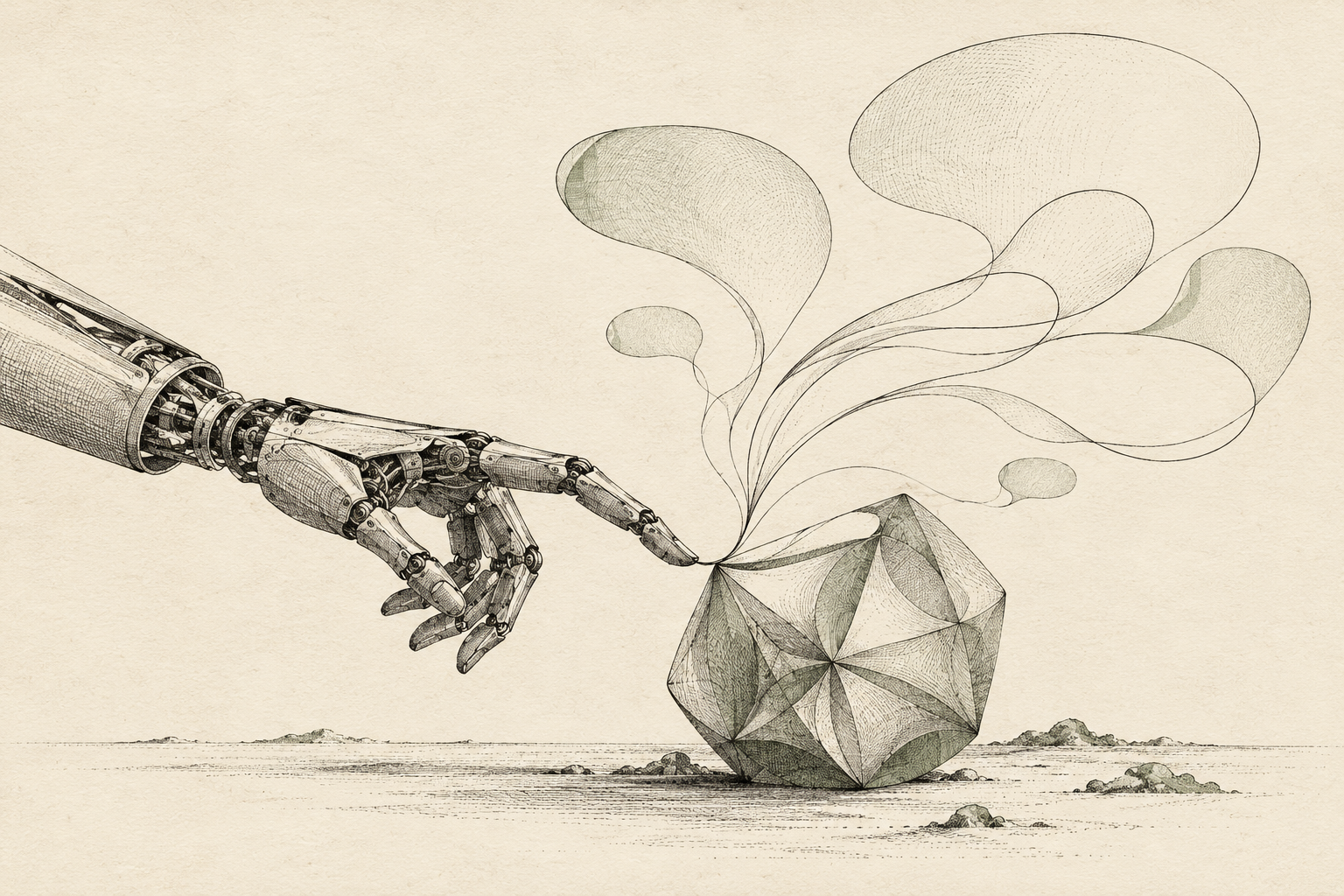
The machine reaches into that blank space. Will what comes back be another correct answer? Or a way of using things that reaches even what it has not yet been shown?