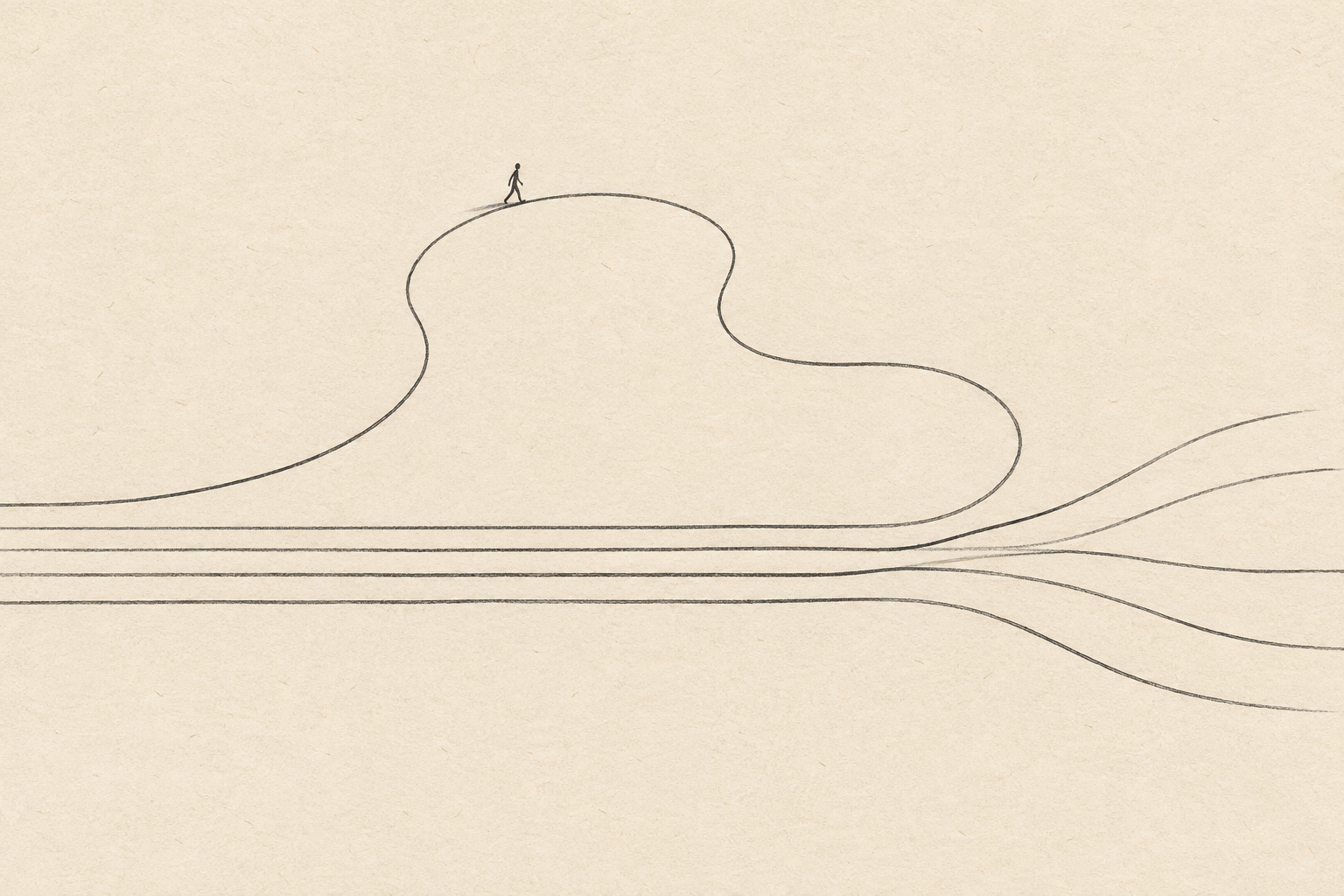
You read an AI’s answer and try approaching the problem from a slightly different direction. You bring in another example. You stop to ask whether this was the right question in the first place. None of that time may leave a name attached to the finished answer.
If the AI puts the final version together, the achievement can look like the AI’s. The human merely made a few requests along the way. Condense the meeting notes enough, and that is roughly how the story goes.
But what if that “along the way” changed the direction of the search?
In the previous Inside the Geek article, we considered three ways of working with AI—directing, co-creating, and following—and asked how people can retain their judgment while delegating work. Here, we turn that relationship around. Alongside “What do people receive from AI?”, let us place another question: what do people give back to the AI’s search?
A short relay in search of an answer
A 2026 study by Chenyi Li and colleagues, “Human-AI Synergy Supports Collective Creative Search,” offers a starting point. Its task is a game: find a hidden English word. Enter a word, and you receive a score reflecting how close its meaning is to the target. No one tells you the route to the answer. You use the score to decide what word to try next.[1]
Each round allows ten guesses, and a game lasts ten rounds. What passes to the next round is the previous round’s highest-scoring word and its score. The reasoning does not travel with it. Neither does the sigh that followed a difficult choice. It is a remarkably quiet handover.
The human participants were 503 native English speakers living in the United States. The researchers compared four conditions: people taking turns, one person completing the whole game, AI alone, and a mixture of people and AI. The main AI model was Gemini 2.5 Flash. In the mixed condition, each round was randomly assigned to either a person or an AI agent.
It is worth pausing before picturing the scene. People and AI were not sitting around a table, discussing their options. The human participants were not even told that some guesses might come from AI. No one had set out to teach an AI the value of a detour. A word left behind became a foothold for the next search. That limited connection was enough for differences to emerge.
Whose performance improved?
The mixed human–AI condition achieved the highest performance, measured by averaging the highest score in each round. But it did not maintain an uncontested lead to the finish. The group in which people took turns improved later in the game and caught up with the mixed condition in rounds nine and ten. The result resists the tidy story that mixing people and AI always produces a runaway victory.[1]
More intriguing is what happened within the mixed condition. AI agents performed better there than they did in the AI-only condition, with an effect size of d = 0.618. The performance difference between people in the mixed condition and people in the human-only relay, however, was not statistically significant (p = .392).
Put people and AI together, and every person becomes much smarter: these findings do not support that reading. What draws the eye instead is a change in AI performance without a substantial difference in the humans’ own scores.
This does not establish that one particular move rescued an AI. The study compares outcomes across conditions; it does not award individual credit for each person’s detour. Still, it leaves a question worth holding onto: might we miss some forms of contribution if we look only at the contributor’s own score?
More detours are not always better
The researchers also examined the diversity of the words produced. They measured the number of distinct guessed words as a proportion of all guesses within each game, then averaged that proportion. The result was 0.37 for AI alone, 0.58 for the mixed human–AI condition, and 0.86 when one person completed an entire game.[1]
The condition that produced the greatest variety of words did not achieve the highest performance. The mixed condition was more diverse than AI alone, but it did not preserve all the variety found in the human-only conditions. Widening the search and pursuing a promising clue: much of the experiment’s interest lies in the space between those two activities.
The authors interpret the findings in terms of complementary approaches: people searching broadly, AI searching more narrowly. But a greater variety of words is not, by itself, a measure of richer or more useful ideas. Add enough irrelevant words and this diversity measure rises too. The value of a journey is not determined by the distance spent lost.
What a person produces is passed on as input, and the behavior that follows differs. There is room to think around that small fact.
The person who changed where to look next
What follows is a reflection prompted by the study.
Imagine reviewing a proposal. In response to the AI’s polished draft, you offer one example that troubled you in practice. The proposal itself may not immediately improve. Yet that example may lead the next round of work to consider a different user or a different situation. It may never appear in the final proposal, while still changing where the search goes.
Can we recognize that kind of involvement as a contribution? The person who wrote the answer, finished the code, or reached the conclusion is relatively easy to see. How do we record the work of someone who changed the direction of thought one step earlier?
This is not a proposal to preserve every human suggestion as a treasure. Some digressions lead nowhere. There are also times when efficient convergence is precisely what is needed. Make the number of detours a performance metric, and we will probably get more reports about detours. That is not quite what we are after.
What matters is how the next search changed in response to an input. Apart from whether someone named the right answer, did their example or question broaden the range of possibilities under consideration? Or did it bring an overly scattered search back to promising ground?
In the experiment, there was a target word and a fixed scoring method. At work, we sometimes need to reconsider what a good result would be. A linear handover is also different from a room in which several people speak at once. This study does not establish that workplace creativity or human capabilities improve. Even with that gap left open, it can shift where we look for a contribution.
What are people bringing to the process of improving an AI’s answers? The exercise of judgment discussed in the previous article need not stop at accepting or rejecting an answer. We might also include the act of asking whether we are looking in the right place.
Do we see only the person who produced the answer—or also the person who changed where the next person, or AI, would look?